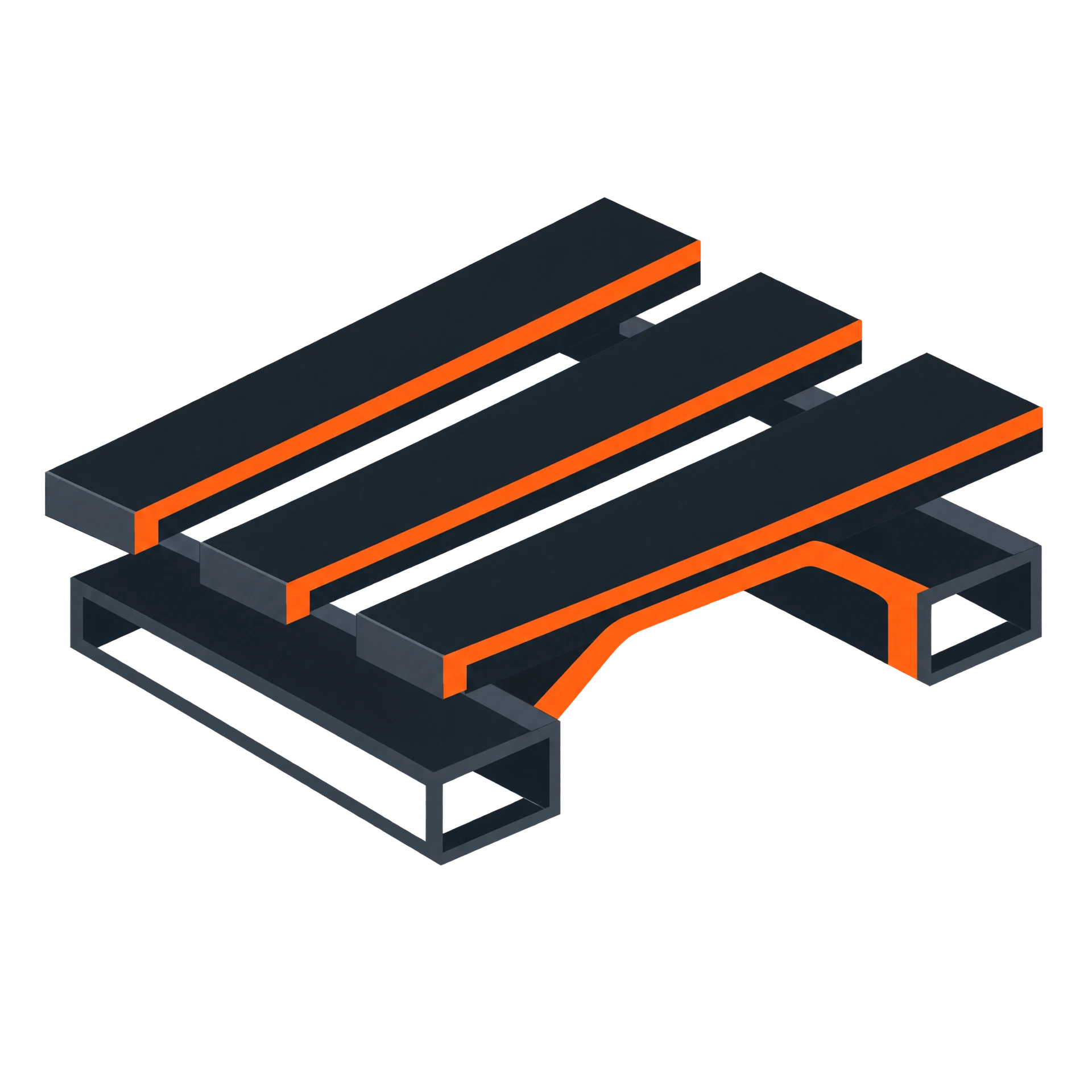
Nesting is an operating state
Start with the empty-return route, then validate the loaded position
Nestable steel pallets are considered where empty units return to a supplier, accumulate beside a production line, or travel back through a distribution loop. The word nestable refers to the way empty units enter one another in an approved direction. It does not automatically describe how the pallet behaves when loaded, how it is lifted, whether it can stand in a loaded stack, or whether it may sit on rack beams. The buyer should therefore describe the empty and loaded states as two distinct parts of the workflow.
A credible nestable-pallet discussion begins with the existing loop: where empties are gathered, how they are separated, who or what moves them, how they are restrained for return transport, and what footprint is available. It then adds the loaded unit: goods envelope, product contact, forklift geometry, floor support, storage position, and any proposed stack or racking condition. Bridgent can use those facts to discuss a project configuration, while exact nesting pitch, clearances, ratings, and operating instructions remain tied to the selected drawing and supplier evidence.
Reference configuration
Reference configuration record for a nestable steel pallet
Use this matrix to prevent empty-return benefits from being confused with the requirements for loaded storage and handling.
| Configuration field | What the project record should show |
|---|---|
| Configuration identity | Identify the selected variant, controlled drawing revision, matching visual record, and whether the record applies to empty nesting, loaded use, or both. |
| Empty nesting state | Define nesting direction, entry and stop features, required clearance, empty accumulation method, separation method, and any debris or cleaning considerations. |
| Loaded unit | Record goods envelope, product-contact locations, load distribution, centre of gravity where relevant, and required product protection. |
| Fork handling | State handling equipment, permitted approach, fork/tine envelope, entry positions, and the movement sequence for loaded and empty units. |
| Storage conditions | Record floor support, any loaded-stack arrangement, and any racking request separately; do not infer one from the nesting geometry. |
| Return packing | Show empty-unit orientation, restraint, protective elements, vehicle or container constraints, and destination recovery method. |
Structure and operating map
Operating-state map: empty nesting versus loaded use
The selected variant needs a drawing or approved instruction that makes each state explicit.
Empty unit
Show one empty pallet, its locating faces, the direction it enters the next unit, and the surfaces that must remain clear.
Nested empty group
Show the approved accumulation or transport pattern, restraint approach, handling point, and separation path.
Loaded pallet
Show goods contact, product envelope, fork-entry geometry, and the support position for the loaded state.
Loaded storage
Show any approved floor, stack, or rack interface separately. Empty nesting is not evidence for any of these positions.
Empty-return planning
Measure the route for empty pallets rather than assuming a return ratio
The usable benefit of nesting depends on the real empty route. Identify how many units are normally accumulated, whether the location is indoors or exposed, how the nested group is lifted, and whether operators must separate one pallet from another by hand or equipment. Record the available floor area, clear height, transport vehicle, doors, aisle widths, and destination unloading method. These details determine whether a compact empty arrangement is genuinely useful or whether it introduces a difficult recovery step.
A supplier should confirm the selected configuration's nesting direction, stop or locating features, clearances, and any operating restriction through a controlled drawing or instruction. Avoid describing an illustrative image as a universal nesting procedure. For an early RFQ, photographs of the current empty return, the desired vehicle space, and a simple sketch of the collection point are often more helpful than a request for a generic standard dimension.
- Describe the empty collection location and the person or equipment that separates units.
- Record the return vehicle or container before asking for a packing pattern.
- State whether loose components, labels, or protective materials must travel with empty units.
- Identify cleaning, moisture, or debris issues that could affect nesting clearance.
Loaded handling
Keep loaded stability independent from the empty nesting concept
The loaded pallet must be evaluated around the goods and its support path. Provide the outer load envelope, contact pattern, load distribution, product protection needs, and any overhang constraint. Then describe the forklift or other equipment: fork width and spacing, entry direction, lift sequence, turning space, and placement surface. A nestable base can have specific lower-frame geometry, so fork clearance and product stability should be reviewed on the actual selected configuration rather than assumed from another pallet family.
If loaded pallets must stack, the project needs a distinct stack interface, placement method, support condition, and approved limitation. If loaded pallets must rest on rack beams, supply beam positions, bearing faces, pallet orientation, and retrieval pattern. Bridgent will not treat an empty-nesting description as a loaded-stack or racking approval. Keeping the conditions separate protects both the buyer’s requirement and the accuracy of the final drawing.
Return shipping and control
Plan empty transport, recovery, and traceability from the outset
Returnable packaging is easier to manage when the pallet state is recognizable. The project brief can define whether the empty unit is returned singly, as a nested group, with a protective cover, with removable accessories, or with a label that identifies the ownership or route. Any marking should remain visible in the required handling state and should not occupy a fork-contact, stack-contact, or nesting face. These details are operational decisions, not generic product features.
For a supplier comparison, ask every bidder to show the same empty and loaded states. Compare the proposed nesting geometry, recovery method, handling access, product-contact arrangement, and drawing-control process. Do not compare an advertised empty footprint against a loaded-storage promise unless both are associated with the exact same configuration and documented operating conditions.
Project sequence
A nestable pallet RFQ sequence
Use a two-state brief so empty-return decisions do not obscure loaded handling requirements.
- 1. Capture the current loop
Photograph or sketch loaded use, empty accumulation, return loading, and destination recovery. Note the problem the new pallet must solve.
- 2. Define empty nesting
Request a drawing-controlled explanation of nesting direction, clearance, accumulation, restraint, and separation for the candidate configuration.
- 3. Define loaded handling
Provide goods envelope, contact map, handling equipment, floor support, and any loaded stack or rack requirement separately.
- 4. Approve the relevant states
Review the selected configuration, operating instructions, inspection points, and packing plan before treating the return loop as fixed.
Product visual reference
Configuration visual evidence in preparation
The previous unrelated visual set has been withheld. An approved, configuration-specific visual and drawing record can be added after product-fit review and branding-cleanup verification.
Procurement and qualification
This route does not display a substitute product gallery
The previous route used portable stackable-rack images, which are not a reliable visual representation of a nestable steel pallet. That mismatch has been removed from this page. A drawing and approved nestable-pallet visual should be added only when the exact selected form has been reviewed for product fit and any third-party brand marks have been removed under the established image policy.
Until that evidence is available, use the operating-state map and the RFQ checklist above to define the configuration. This is more useful than showing an unrelated product photograph that could lead a buyer to assume a particular nesting method, loaded-stack capability, or rack interface.
Sample, batch, and packing discussion
Confirm the empty and loaded states before discussing a batch route
A nestable pallet sample or drawing review should show the selected empty nesting direction, separation method, loaded product contact, fork interface, and proposed return packing state. Whether a sample can be supplied, and on what scope or timing, must be confirmed for the project rather than assumed from a product category.
For a repeat batch, retain the controlled configuration identity, empty-group packing instruction, restraint and component plan, product-handling notes, and destination recovery method. This is the practical record that lets a purchasing team compare like-for-like returnable proposals.
Frequently asked questions
Questions to resolve before requesting a quote
Does a nestable steel pallet stack when it is loaded?
Not necessarily. Nesting describes an empty-unit geometry. Loaded stacking must be confirmed for the selected configuration, load, contact points, support condition, and operating procedure.
Can a nestable pallet be used in pallet racking?
Only if the selected configuration is reviewed against the actual beam support geometry, pallet orientation, load placement, and operating requirements. Nesting alone does not establish racking suitability.
What information is needed to compare empty-return options?
Provide the current empty accumulation method, return vehicle or container, required collection footprint, handling equipment, recovery method, destination constraints, and the selected pallet drawing where available.
Why is there no product gallery on this page?
An unrelated stackable-rack gallery was removed to avoid a misleading visual match. Approved nestable-pallet images can be added when a configuration-specific, brand-clean visual record is available.